reabc/The Dragon and the Hydra - Russell Maroon Shoats/The Dragon and the Hydra - Russell Maroon Shoats.pdf
Web PDF • Imposed PDF• Raw TXT (OCR)


![planct; daly devouring children, womym, people of color, the poor, workers of all stripes, wildlife and the environment in pursuit of profits. Al of our problems primarily reston the artifical division tht have bee] engendered between the oppressed fo hundreds ofyear, divisions based on gender, race, ethnicity, culture, geography, sexual preferences, age, and otherwise. These divisions have been fostered—historically—by those who have sought to use them in their pursuit of power and material gain. Under imperialism, the overwhelming majorlty of our planet’s humans are— ultimately—workers. Thus Marx’s address to the [WMA still holds true today, although he underestimated the degree of opposition the workers would face and the length of time it would take for them to overcome all of the obstacles in their path. Marx, superb analyst that he was, due to the ewrocentric predilections that entrapped him, overlooked or dismissed important workers" struggles that fell outside of Europe; or he at least failed 10 study them with the same intensity that he devoted to those European situations that he (primarily) based his—otherwise .. well based analysis upon. That sct in motion other willful neglect in formulating a proper evaluation of these “other” struggles up unil today even. And i’s a thorough study, evaluation, adapation (whercver applicable) and undersanding of some of these workers struggles that will ‘help us move forward in our struggle against imperialism. There we’ll find proven, workable alternatives to the flawed DC forms of organizing; ones that miror Stan Goff’s analysis of the strengths of the carly Bolsheviks’ use of that form. Back to the Future First off, let me state that I’m ot an Anarchist. Vet lot of what you’llread here is gonna look a whole lot like Anarchism! To that I will only quote an unknown ancient, who after racking his brain to formulate answers to vexing problems, only lter o discover that those who had come along before him had already expounded on what he thought were intellectual inventions, is supposed to have blurted, “confound those ancients, they’ve stolen all of our best ideas.” ‘Therefore, to the Anarchist reader, what follows cannor properly be termed Anarchism, simply because the practitioners themselves never knew that word, nor were they in contact with people of that view, as Anarchism is a European ideology and these parties—for the most part—were Africans and Amerindians, with very limited input by a small number of outcast Europeans. Further, al of the struggles written about here had pretty much taken off and gained success prior to the spread of that concept —under it classical Anarchist thinkers and practitioners. Stil,the affinity between Anarchism and the following is ot rejected; on the contrary, it’s welcomed as a sister set of ideas, and concepts—as long as the Anarchist understands that they stand on an equal footing, in a spirit of /nter- Communal Self Determination.](The Dragon and the Hydra - Russell Maroon Shoats 4.png)


![Within two years of the beginning of the French Revolution and continuing for 12 harrowing years, the Haitian revolutionaries would go on to militarily engage and defeat irst their colonial cnslavers and afterward a succession of armies fielded by Spain and England, as well as traitorous Mulatto army and fially tens of 4 thousands of Napoleon Bonaparte’s veteran French “revolutionary” troops. The. victorious Africans would go on to found the country of Haiti in 1803/1804, the only country in world history established by formerly enslaved workers. ‘What better example could we use to weigh Manx’s words about the “workers engaging in” 15, 20, 50 years of civil wars and peoples’ struggles to go through...in order to change yourself and make yourself fit for political rule” (rf cited). ‘The Marxist giant, C.L.R. James, who penned the classic Black Jacobins, dissccts that struggle. In i, James compares the Hailian revolutionary ammy led by Toussaint and later Jean Jacques Dessalines and Henry Christophe with the later Russian Bolshevik Party: “(Toussaint and]...his Black army generals filling the political role of the Bolshevik Party” (James, p. 283). This brilliantly led, tightly organized and courageous army represents my Dragon here. And James’ book does much to rescue them from the shadows of history for our study. They are the ones who Wwould surface as the most notable clements, while scores of the decentralized receded 1o the background. So on first reading about them you would think thatthis centralized Dragon was the revolutionaries" best weapon. But the European empire builders of France, England, Spain - and the U.S. wannabes- were not going to give up, even though they all had been defeated or were afraid to dircetly intervene- in the case of the us. As it tumed out, however, with Toussaint backed by the “revolutionary” army assuming the govemorship of the island, the imperialists pressured and mancuvered himinto a position where he and his (Dragon) army began to impose conditions o the revolutionary masses of workers that were intolerable. “In the north around Plaisance, Limbe, Don don, the vanguard (masses) of the revolution was not satisfied with the new regime” (James, pp. 275-276). And astonishingly, in the tecth of Napoleon’s renewed threats and the hostile machinations of the British and Americans, “Toussaint submits- along with his generals” (James, pp. 325-327). ‘Thus in one fell swoop, these leaders had been forced to. play the role of neo- olonial compradors. Our Dragon had been corralled, handcuffed and chained and they subsequently set out to use the “revolutionary army” to deliver the masses back into slavery! Simply because Napoleon feared them, his secret plan was to place all of Haitis Africans back into chattel slavery; he seat his brothec-in-law and (eventually) 60,000 more French troops to accomplish his aims. Recognizing the weaknesses of the Dragon forces and the true intentions of the French, *{Lamour) Durance and the petty chiefains, north, south and west, each i his own district summoned Blacks to revolt.” (James, p. 327). So here we see the Hydra battling the (now) traitorous Dragon and the French imperialists,](The Dragon and the Hydra - Russell Maroon Shoats 14.png)
![“Itis a recurrent ale, this (Dessalines and his generals hunting down these “Brigands"). “Once more the masses had shown greater political understanding than their leaders” (James, pp. 338-339 and footnote 39). Our formerly heroic revolutionary army had been reduced to suppressing the revolutionary masses and forcing the later into “... fighting Black gencrals [who were)] trying to crush the “Brigands’ forthe French,” [propelling our Hydra back to center stages]. “The litle Tocal leaders...beat off[their and the French) attacks...causing the French to be. more open to yellow fever” (James, pp. 346-347). I Consequently we witness the decentralized Hydra clements launching the. revolution, being displaced by Toussaint’s army- the Dragon- only to resume their leadership roles during a crisis that saw the Dragon capitulate to the French, thus showing itself s the most indispensable weapon that revolutionaries developed. Later, as s well known, Toussaint was kidnapped and taken to France where he later died in prison. This opened the way for his chief licutenant Jean Jacques Dessalines to (again) switch back to the rebels’ side, rally the revolutionary army (o also switch back to the masses" side, and along with the Hydra forces go on to totally annihilate the remaining French forces on the island, declare independence and appoint himself the new country’s Emperor. ‘An excellent soldier, Dessalines showed himself to be a cruel tyrant over the Haitian people. Thus he was assassinated by them within a few years of assuming power. He was replaced by another general from the Dragon forces: Henry Christophe, who was appointed president in 1807. By 1811 he had declared himsell king. He too would be killed by his own people in 1829. Thus we can clearly see how Haiti’s Dragon forces played a very ambi role in the rebel fight for independence They started out as tenacious and brilliant fighters against all of the Europeans imperial and colonial elements and the traitors amongst the Mulattoes who were all bent on keeping the enslaved Africans underfoot. During the course of the revolutionary struggle they all opportunistically switched to the French imperialists’ side and went on to attempt to drown the still revolutionary masses and their decentralized groups in blood; that way the French would allow them to serve as a new elite class of African policemen against a re- enslaved Affican workers” class. Failing to suppress the rebels, the Dragon forces rejoined the Hydra elements and lent their weight to totally defeating the French, only to once again turn against the revolutionary masses by establishing themselves as a dictatorial and exploitative Afican elite. For its part the decentralized Hydra forces never veered from their objectives of winning as much freedom from servitude and oppression as possible, From the pre-revolutionary times of Mackandal up through the 17911804 Haitian Revolutionary War, and even down to our time, they "ve continued to struggle towards those ends. And its highly instructive to know that in addition to fighting the French during their revolution, they were also under attack by Toussaint’s Dragon forces, who displayed hatred and fear of everything from their refusal to relinquish their Maroon/decentralized organizational formations to their practice of](The Dragon and the Hydra - Russell Maroon Shoats 15.png)

![that what was needed was some crisis in the society such as a depression or a war. ‘With none of these factorsin place, the workers of Hungary in 48 hours took over all of the means of production in that society, created a form of dual power, forced the Communist Party to reorganize under another name, and was crushed by nothing in Hungarian society—but by an invasion of Soviet tanks. 17 [And in his own words] “James wrote, ‘Now if the pasty is the knowing of the proletaria, then the coming of age of the proletariat means the abolition of the party. Thatis our universal, stated inits baldest and most abstract form... The party as we know it must disappear. It s disappearing. 1t will disappear as the state will disappear. The whole Iaboring population becomes the state. That s the disappearance of the tate. It can have no other meaning. It withers away by expanding to such a degree that it is transformed into its opposite. And the party does the same...For ifthe party does not wither away, the state never will* “On the other hand, even after the fact, the Ief could not deal with cvents that demolished their theories of the necessity of a vanguard party, and proceeded to ignore the movements in Hungary, in France and in Poland- movements which Marx or Lenin would have pounced on to study and to hone and bring up to date Conclusion 10 clear that today’s center of gravity, the aspects on which all else is dependent and rests is the shared (global) consciousness of the multitudes of the arth’s workers and oppressed peoples, that their lives are daily becoming more and ‘more intolerable, hence solidifying them ideologically around the necessity for revolutionary change (like our earlier Maroons were solidified around the need to escape enslavement), and the ability of these mulfitudes to communicate with each other and share ideas and methods about the best ways to proceed towards that goal. Therefore, the global hardships brought about by today’s imperialists and their ‘oracious accumulation of wealth and their destruction of the environment and cultures will propel the multitudes to use any and all means to bring about the. needed changes- or perish. And modern means of communications will provide them with the means t0 both update and imitate the earlier Hydras’ strengths and avoid its weaknesses while guarding against the tendency of the Dragons to concentrate oppressive power in its hands. ‘Thus, since both the shared needs and necessity for change is already preseut, along with the tools to communicate, then our final consideration is whether or not these masses must centralize their organizing (not 1o be confused with the obvious This is e absoltey el staement i erms f polieal paris todny. Poliical organization of the old pary e i Getain o il oppress,and tyannize over the working clas. The party formta hs been xhoasted. ther words, e modem polical party, whateve s olicy o program, th moment i nkes hold over goverament, wheever it democric nenions, becomes sysiem, method and organization which i oppose 10 the masses o the people. The oly way you can ook frward o that being changed i by a formation of independent counciseverywhere.* (ames, pp 156-157) lcsae mine)](The Dragon and the Hydra - Russell Maroon Shoats 17.png)


The Dragon and the Hydra:
A Historical Study of
Organizational Methods
R uss:u"r\AnuoN"sumS
By Russell “Maroon” Shoatz
The Dragon and the Hydra: A Historical Study of Organizational Methods
By Russell “Maroon” Shostz
You have ffteen, twenty, fify yeas of civil wars and people’s struggles o go
through, notonly to change the conditions, but in order to change yourselves and
make yourselves it for poliical rul
Karl Marx addressing he IWMA—the body that later became the First Interntional
Man’s words hit close to home. I've been involved in such movements for
40 years, a product—originally—of the Black Liboration Movement of the 1960's,
and subsequently being held as a political prisoner in the U.S. since 1972, And
over that period I've participated in a number of mass and party formations. And it
never fails 1o amaze me how much energy and time is dedicated towards
establishing various groups’ claims to being the so-called vanguard of some
struggle for justice, when in the end most of these exercises turn out to be sterile,
when they don't degenerate into fratricidal conflicts.
Furthermore, I'd hazard it o say, that the entire history of Marxist-Leninist
social change has known few other methods. Leading me to further say that a sober
analysis of that history points to a sruggle for supremacy—not only over the
hourgeois ruling class, but also against the working class and all other oppressed
people: against any and all formaions either of the later pull together that escape
their control. Thus, their mantra of doing everything o seize power for the working,
class and oppressed is a farce.
17 there has ever been a Marist-Leninist vanguard party that has found itself
in power and did not subsequently follow that script, 'm not aware of t. And
while arguments can always be found to rationalze wh it wasfis necessary to
resert o such measures, and many such arguments do make sensc—initially—a
sloser look always seems to force adherents to fall back on the mantra of the flawed
individual(s) who did not hold true to Democratic Centralism's (DC) principles
which are themselves wide open to interpretation and manipulation), in order to
swize the iniiative in a struggle for domination—as opposed to trying to make
“concrete analysis of concrete conditions,” as V.1. Lenin instructed.
1 had reached these conclusions on my own. But later | was astounded to
am that the Marxist giant C.L.R. James (the author of the theory that scientifically
2xplains state capitalism, and the mentor of the African revolutionaries Jomo
Cenyafta and Kwame Nkrumsh—who brought both Kenya and Ghana our of
olonialism—as early as 1963) had said:
‘We have repudiated the conception of the vangurd paty. That conception
rined the socalst movement, and the movement of the proletaia, for 3
everarion.The vanguard party conception rined all artempts to form a Marxist
party inthe 115, and contributed substantially to the catastrophes which have
cfullcn 1. Whot has happened in that thei whole oulook and mentaliy hve
e dominated by the coneptof the vanguard party which had o teach the
peonte about Manxism, and other such matters which would make the people
understand that they, the preachers, were the ones who should be followed as they
were the leaders of the sociaist revolutio.. The whole St
E4
‘whole Nezi regime, are not the resultof evil men. They are the result o the dive
towards the unification of th executive and politcal organization of allaspects of
thesate [DC'shistorical modus operandi, which is supervised and enforced by
the vanguard party).
LR James, Marxiom for Our Times: C.L.R. James on Revolutionary
Organization
At the same time, history has shown that such ruthless methods are effective:
iffthe objectives of those who used the DC methods were simply to scize power,
thea their record during the 20® century was impressive. Its proved itself as
brutally efficient and capable of matching or outdoing anything the bourgeois forces
are capable of.
Nevertheless, in the end, those who gained power using the DC method have
abways ended up using it o defeat the aspirations of the workers and oppressed, and
subsequeatly instal the users of it as 2 new oppressive ruling class.
How could it be expested to produce any other outcome?! DC coneenirates
‘more power in the hauds of a rlative few, than any mechanisms the masscs the
former purport to be serving can muster: a recipe thats bound to conflict with the
vagaries of flawed humans.
Stan Goff, in his masterful Full Spectrum Disorder (2004, Soft Skull Press),
believes that DC as practiced by Lenin and his Bolsheviks did have a democratic
basis, whereby an open and intense democratic struggle was carried out in order o
amive at positions and policies, and then all the party workers would move in a
decentralized—frec wheeling—manner to make possible the implementation of
thase decisions (in the teeth of czarist repression), which ultimately had the effec:
of centralizing their combined efforts. Only later 10 change their methods, which
led 10 more—all around—centralization and very linle democracy, if any.
‘And without a doubr, any number of other Marxist-Leninist-Maoist (style)
‘groups have had similar experiences.
‘Yet, if the clear historical tendency is 1o always gravitate towards fess
democratic.and more oppressive forms of control, then quite frankly for one to say
their use of Historical Materialism is leading them to formulate correct liberation
ideas, theories and plans by using DC is ludicrous!
The Contemporary Situation
Here we are at the beginning of the 21 century, facing a global crisis
‘unknown heretofore in the entire histary of humankind. The threats to our collective
existence are so multidimensional that it would take many other works to detail
them all. Consequently, I'lllimit myself 1o those that [ believe are paramount to
helping us break out of a self-imposed mental roadblock that hinders our efforts to
move forward.
TM‘min threat to humankind, the flora and fauna, and our entire biosphere is
capitalist imperialism. A totally out of control, predatory, global system of
accumlation and oppression that's on a collision course with the limitations of our
planct; daly devouring children, womym, people of color, the poor, workers of all
stripes, wildlife and the environment in pursuit of profits.
Al of our problems primarily reston the artifical division tht have bee]
engendered between the oppressed fo hundreds ofyear, divisions based on gender,
race, ethnicity, culture, geography, sexual preferences, age, and otherwise. These
divisions have been fostered—historically—by those who have sought to use them
in their pursuit of power and material gain.
Under imperialism, the overwhelming majorlty of our planet's humans are—
ultimately—workers. Thus Marx’s address to the [WMA still holds true today,
although he underestimated the degree of opposition the workers would face and
the length of time it would take for them to overcome all of the obstacles in their
path.
Marx, superb analyst that he was, due to the ewrocentric predilections that
entrapped him, overlooked or dismissed important workers" struggles that fell
outside of Europe; or he at least failed 10 study them with the same intensity that he
devoted to those European situations that he (primarily) based his—otherwise ..
well based analysis upon. That sct in motion other willful neglect in formulating a
proper evaluation of these “other” struggles up unil today even. And i's a
thorough study, evaluation, adapation (whercver applicable) and undersanding of
some of these workers struggles that will ‘help us move forward in our struggle
against imperialism. There we'll find proven, workable alternatives to the flawed
DC forms of organizing; ones that miror Stan Goff's analysis of the strengths of
the carly Bolsheviks' use of that form.
Back to the Future
First off, let me state that I'm ot an Anarchist. Vet lot of what you'llread
here is gonna look a whole lot like Anarchism! To that I will only quote an
unknown ancient, who after racking his brain to formulate answers to vexing
problems, only lter o discover that those who had come along before him had
already expounded on what he thought were intellectual inventions, is supposed to
have blurted, “confound those ancients, they've stolen all of our best ideas.”
‘Therefore, to the Anarchist reader, what follows cannor properly be termed
Anarchism, simply because the practitioners themselves never knew that word, nor
were they in contact with people of that view, as Anarchism is a European ideology
and these parties—for the most part—were Africans and Amerindians, with very
limited input by a small number of outcast Europeans. Further, al of the struggles
written about here had pretty much taken off and gained success prior to the spread
of that concept —under it classical Anarchist thinkers and practitioners.
Stil,the affinity between Anarchism and the following is ot rejected; on the
contrary, it's welcomed as a sister set of ideas, and concepts—as long as the
Anarchist understands that they stand on an equal footing, in a spirit of /nter-
Communal Self Determination.
s
Historical Overview
The following is a shart outline of various workers struggles agains carly
European imperialism, as practiced in Suriname, Jamaica, a number of souther
areas of what is today the U.S., and finally Haiti. Ill outline how workers who had
been enslaved fought longer than Marx's “fifeen, tweaty, ffty years of civil wars
and people’s struggles...” in order 10 ultimately be able 1o exercise their own forms
of self-determination and “political rule.” And although all of them were as
stratified as we are today, (they came from different ethnic groups, spoke many
ifferent languages, practiced different eligions and some had been enemies and
had waged war on cach other in Africa) they were still able (o democratically derive
methods and policies that were collectively pursued by decentralized formations of
their own making. And once winning their freedom from the various imperialist
powers, unlike the later states ruled by Marxist vanguard formations, they never
‘again relinguished their workers-based autonomy—uniilthis day; with one
‘exception (Haiti), which deserves special attention.
‘Aferwards, hope that you do your own in-depth research and study, because
o most people, the bulk of this history will be unfamiliar.
Suriname
“We must slay the Hydra'." That was the Dutch imperialists’ main concern in
Suriname from their earliest days there.
On the modern coast of South America, this tropical country borders Guyana
and French Guiana and fronts the Caribbean Sea, with Brazil 10 its south.
Geographically, it is about one-third-again as large as Cuba.
‘The first European interlopers to visit the area were the British, who were:
followed by the Dutch. And although it changed hands between them, the Dutch
were the main imperial power {0 occupy the country from the mid 1600's, up uatil
the 1970’s. Al during that period, the overwhelming majority of the indigenous
Amerindian populations were cither suppressed, forced 10 fle to less hospitable.
arcas, or exterminated.
“The Dutch at that time were one of the world’s major imperial powers, vying
alongside the British, Spanish, Danish, Portuguese and the French for control of
North and South America, the Caribbean, and other places in the world.
‘The Dutch West Indies Company was one of the first and major corporations
in the world. And in Suriname they launched plantation-based production of cash
crops on a large scale—using enslaved workers imported from different parts of
Africa. Added to that were a number of other plantations other European
“entrepreneurs,” along with their overseers, shopkeepers, militias, artisans,
‘administrators, bureaucrats and sailors; along with a small percentage of (mostly)
poor white womyn who had been exiled from Europe.
" Hydr:In reek mythlogy a many-headed morsie, whose heads regrew when sk off. Jtwas fially
illd by Hereales. A8 the lrpest and longes constellaion i he sky, bt with o pasculs brghtsa.
Other than the enslaved Africans and suppressed Amerindians, everyone but
the plantation owners could be compared to today s labor aristocracy and petty
bourgeoisic. Since they were all fully dependent for their livelihoods and protection
on the Dutch imperalist, they helped keop the system i place. A
T made those comparisons because we all t00 often fal to point out that the
enslaved Africans were transporied across the Atlantic o assurac the role of
workers, and just about everyone else associated with their plizht were also—first
‘and foremost—other workers, similar to our plight today. And the issue of race did
not—could not—change that basic fact! So keep that in mind as we develop this
work.
Amongst the Africans were many different ethnic groups from different areas
of the continent, al speaking differcnt languages and with many varied religious
and cultural practices. And to give an idea of the stratification of these Africans,
the fact that they all had dark skins meant next to nothing to them—in terms of
solidarity. Where they originally came from everybody had dark skin, friend and
enemics alike! Further, it was the practice of the plantation owners to try to
purchase workers from different backgrounds in order to Aeep them divided as
much as possible. And because the work was 5o brutal and the food was so
inadequate, most plantations were really death camps, where the African workers
were literally worked to death in a few years, only to be replaced with newly
imported enslaved workers, who would also go on to make handsome profis for the
owners. Thus the tum over itself was a powerful check on the formation of any
solidarity between the enslaved workers.
B that as it may, almost from the first importation of enslaved Africans, there
developed a tradition of light from slavery: Africans running away to the foreats,
swamps and highlands. These fugitives came to be known as Bosch Creools: Duich
for Bush Creoles, or “born in the forest” and later Bush Negroes, who we'll call
Maroons throughout our study, as a generic name that has come to be used as an
accepled way (o describe fugitive, enslaved people throughout the western
hemisphere.
Throughout the western hemisphere, we witness these collective Maroons
devcloping and using a very effective form of decentralized organizing tht not
only served to help them defeat their former enslavers, but has helped them to
remain autonomous from all unwanted overseers for hundreds of years—until our
time.
Itmust be recalled that the Suriname Africans were from many different
backgrounds; so when they would come together as Maroons that would have to be
factored in: they had to organize using democratic methods. The glue that held
them together was their collective focus on defeating their enslavers” attempts to
control them; it was this collective focus that centralized their florts,
There remained, however, one class within their communities that did not it
into that catcgory: those Africans who did not flee, but were forced by Maroon
raiders (0 leave their plantations. They did not enjoy a say in thtir new
ity's affairs until they had proven themselves.
But as a general rule, individuals and small groups would flee the plantations
to join the Maroons, and on occasions large conspiracies were organized that saw
the enslaved workers preparing the groundwork for Maroon guerrillas 10 raid
plantations and liberate scores ata ime. 7
‘The latter example exhibits decisions arrived at by truly democratic means
and then carried out in a cetralized maner, all done by otherwise decentralized
groups. Long before our later Bolsheviks!
Over a 150 year period, the various Maroon communities of Suriname waged
a guerrilla war with the Dutch and English slavers to remain free. And today in
Suriname, ther direct descendents still occupy the areas their ancestors fought on.
Most of them have never suffered under slavery—even before the U.S. signed its
‘own Declaration of Independence in 1776.
Even s this is written, they remain aufonomous from the goverment of
Suriname—which gained its independence from the Netherlands (whose Dutch
ancestors we're discussing) in 1975. In fact, the descendents of the carly Maroons
‘were again forced to fight another guenrilla war against the newly independent
govemment in 1980; a successful effort on the part of the Maroons to maintain their
‘autonomy and control over the lands they*ve historically occupied.
‘Their decentralized methods had their drawbacks. Their enemies in the
imperialist camp had the ability to manipulate various Maroon communities into
signing “treaties” that gave those communities their freedom from enslavement and
land 10 use—in exchange for their cooperation in hunting down and capturing other
fugitives. By doing that the enslavers could avoid the all but useless wars designed
10 capture or kill the skillful Maroon guerrillas-—- and everyone in the Maroon
communities fell into that category. At the drop of a hat, the womyn and children
in those communities could pack their belongings and escape to pre-arranged and
built-up alterative settlements, while the men (and some womyn) busied
themselves n fighting rear guard actions against the pursuing colonial soldicrs.
1t turs out, however, that although the treaties did solve some of the
imperialist’s problems, the Suriname Maroons never really fulfilled their
obligations 10 help the imperialists hunt and capture other Maroons. A narmative of
the Dutch force's generations-long wars designed to cither capture or kill the Boni
Maroons is instructive in that regard (sce the Boni Maroon Wars in Suriname)
By the mid 18 century, the Dutch had been forced by over a century of
Maroon guerrilla wariare to sign tratics with three of the most powerful Maroon
‘communities: the Ndjuka, Saramaka and the Matawai. All of these Marcon
‘communities had evolved over generations from fugitive Africans—from many
different backgrounds—into new ethcities, which adopted the already mentioned
names. Most importantly, they had soundly defeated all of the imperialist forces
fielded to capture or kill them, while continuing to expand their numbers and offer
an ever-growing threat o the Dutch colony.
‘The treatics came with yearly “gifls” of all kinds of commodities that the
Dutch would deliver to the Maroons: textiles, pots and pans, guns, powder, axes,
knives, miors, nail, liquor, and just about anything agreed upon during the
periodic sit-downs between the parties. The underlying objectives of the
imperialists were to both rid themselves of a dangerous enemy and tum them into
valuable alles. g
Yet, once it became known (o the sil enslaved African workers that they
zould no longer rely on the Njuka, Saramaka and Matawai for refuge and
arotection, they began to seek out smaller Maroon concentrations. In the early
17005, one of those small groups was headed by an African named Asikan
Sylvester. Bom into this group was a child called Boni, His mother was a fugitive
Affican and his father either African or Amerindian. Subscquently, the group chose
3oni lobch!mwh‘lélfiuA:ikmhmtmoldmminMpmifion “This
sroup of Maroons would eventually become known to the Dutch as a new center of
‘esistance, and for the next two generations, Boni would lead them and they would
e known 10 history as the Boni Maroons—becoming an ethnicity. Thus, the Boni
Maroons just replicated what the imperialsts thought they were suppressing by the
signing of the treaties with the other Maroons. Consequently, they would not sign
1ny more treaties with cither the Bonis or any other Maroons—sp until the end of
he slave period.
Boni—for his part—would lead his group to aggressively wage war on the
mperialists until his death in his mid-sixties.
Vet even while the Bonis became the main fighting force amongst all of those.
Maroons who were still at war with the Dutch, they still observed and respected the
femocratic wishes of any fugitives or Maroon groups they dealt with, never trying
o centralize all control i their hands. And although they were past masters n the
15¢ of coordinated guerrilla campaigns amongst all of the decentralized groups—
during which a unified command was essential—they still never demanded that
sveryone integrate themselves into the Boni community or put themselves directly
ander Boni—except when participating in agreed upon guerrilla campaigns and
Juring rids. Thus the Dutch recorded their knowledge of the frequent coming.
ogether of the decentralized fighters of Kormantin Kodjo, Chief Puja, Boni and
3aron during large campaigns which separated and remained decentralized and
wtonomous otherwise. Furthermore, these decentralized and autonomous
ommunities also lived in different fortified Maroon villages, which were all ‘highly
nobile and self suffcient, making it impossible for the Dutch to capture or kil all
o them at any given time. And even when successful attacks were carried out
vgainsi certain villages, the flccing remnants of those villages always found refuge
n other pre-huilt dwellings or amongst other scattered communities that were still
nctioning.
And since there was never any centralized leadership that the Dutch could
10pe 10 eradicate, they were stuck with trying to cut off every one of the Hydra's
reads,
Unlike the “Treaty Maroons,” they never became dependent upon the
‘mperialists for anything. Instead they relied on their raiding capabilities to capture
2uns. powder, cannons, and other useful items. Moreover, they had perfected
methods of large scale, open field agriculture that allowed them to raise, harvest and
store more food then they could consume—along with more farm animals than they
<ould se to supplement their diets.
Dutch soldiers recorded discovering Boni and related Maroon fields that took
them an hour one way and 30 minutes the other way o mark off for destruction,
along with so many domesticated chickens that they had to slaughter the excess
after feasting on them for days. They and their Maroon foes always noted how
much better the Maroons were fed, and how much betier physical specimens the
Maroons showed themselves to be. It became a prime motivaor of the Dutch led
r00ps o hun forand locate Maroon food stores and farm aninals in order (0. §
supplement their own poor diets.
During the final major Dutch campaign in the Second Boni Maroon War, an
expeditionary force of 1,600 Dutch regulars and European mercenaries
‘accompanied by thousands more colonial soldiers and caslaved African workers
and “free negro rangers” was also unsuccessful. The commander returmed to
Europe with less then a dozen of the force he'd led to Suriname, and died himself
within a year.
From then until the end of slavery, the Dutch relied on treachery—in trying 1o
‘manipulate the various treaties and (stil) fighting Maroons against cach other. And
although they did succeed in getting a younger—less experienced—generation of
treaty Maroons to assassinate Boni, Chief Puja and Kormantin Kodjo (who were all
old men who had tumed over their leadership to younger Maroons), the other
fighting Maroons continued to exercise their autonomy until slavery was abolished.
‘And today the Boni Maroons stil live autonomously in Suriname and next door in
French Guiana. And today in Suriname proper, there are more then 70 thousand
direct descendents of the “Bush Negroes.”
‘The Dutch imperialists tried their best to slay the Hydra! They failed. Was it
because the Maroons' decentralized formations prevented the Dutch from
concentrating theis superior resources against any one centralized leadership—any
bright star? I think 5o.
Have the variols Bush Negro ethnicities been able to maintain their autonom)
over hundreds of years against all oppressive forces through their refusal (o allow
themselves to be subjugated by any broad centralized forces? I think 5o again.
1t's important for the reader (o understand that this history does not sit well
within a eurocentric historical context. Meaning that the things 1'm outlining are sc
foreign to most people that it will be necessary 1o do some serious research and
analysis to avoid rejecting my thesis out of hand—no matter how much information
1 bring forth.
For the Marxistinfluenced reader, it'slike C.L.R. James wrote long ago:
“The clasics of Marxism are “European” in origin and content. They “require”
‘more then an ordinary knowledge of European *history” and paricularly by an
American worker... Capial is ot only a study of abstract capitalism. It i the
“history” of “English” captalist development and there i no fner inroduction 0
For the average American worker these books 858
James, pages 18-19
S0 do your rescarch before you attempt o reach a firm conclusion about my
thesis!
Jamaica
Across the Caribbean Sea from Suriname—in Jamaica—from as early as the
16505 there developed similar decentralized Maroon communities. Only there they
were fighting against the local enslavers of the British empire. After generations of
unsuccessful campaigns by the British against the Maroon guerrillas, they too hit on
the necessity of trying to divide the fighting Maroons from their main source of new
recruits: the enslaved African workers. So the British offered the Maroons
“treaties” similar 1o those in Suriname.
o force the British to adopt such methods, the Maroons fought tenaciously,
skillfully and bravely for over 100 years! And even though there (also) we witness
a number of decentralized groups, they roughly came to be recognized as the
Windward or Leeward Maroons. The former were located in the eastem
(Windward) end of Jamaica, and the latter on the westen (Leeward) side. History
records the most noted Maroon of the Windwards as an African womyn named
Granny Nanny—who even had a town named after her in Maroon liberated
territory. Indeed, Nanny Town became the center of the resistance to British
plantation imperialism in Jamaica, the headquarters from which the Maroon bands
almost succeeded in driving all of the imperialsts from the island all together—
even though British soldiers captured and bumed Nanny Town on a number of
occasions. .
‘The dominant personality amongst the Leewards was an African man named
Kodjo. History records Kodjo as leading a tightly controlled and centralized
operation. And when the Windwards had to make a trek across the island during
one fierce suppression effort, seeking the Leewards" help, even Kodjo could not
force them to abandon their autonomy.
Tellingly. it was Granny Nanny who led a segment of decentralized
indwards (0 resist signing the treaties the longest. She went as far as to have the
British envoys killed on more then one occasion and only submitted after Kodjo and
all of the male Maroons heads had capitulated.
After that, these Maroons were used o help the British hunt and capture new
runaways, as well as suppress revolts amongst the still enslaved African workers,
although they fiercely clung to the freedom and autonoms they and their ancestors
had fought for! ;
In fact, over a generation later their escendents would again engage the
Biish in the Trelawny War in the middle 1790s, during which a mere 267 Maroon
guerrillas fought thousands of Britsh soldiers, local militia and enslaved Africans 1
102 complete stand stil.
They, however, were also tricked and placed on boats to be deported to
Canada—and later to Africa after accepting a truce.
Even so, from then until our time, the descendents of those remaining Maroon
communities in Jamaica still continue 10 occupy the lands they fought on, and
they ve never recognized any overlords: neither the lter Brtish or Black
govemments!
‘The United States
Itis ironic that those of us who live in the U.S continue to neglect to
thoroughly study and critique the wealth of documented history abou the anti-
imperialist and anti-expansionist struggles that have occurred here since the
Europeans fist started colonizing this area, other than the well known Native
American suppression and genocide.
Like the volumes of works written about the civil rights and Black liberation
struggle of the 1960°s and 1970's, the early labor movement and reconstruction
period, there's a mountain of other revolutionary material we can learn from. And
‘not surprisingly, that information concems the struggles of enslaved workers on
these shores prior to the abolition of chattel slavery. In fact, it mirtors the alrcady
mentioned struggles in Suriname and Jamaica, with the important distinction that it
encompasses multi-racial aspects—more 5o than in cither of the former cases.
Namely, in the U.S., until the abolition of slavery, Africans, Amerindians and
Europeans (in certain arcas),allied themselves to fight against the imperialist and
expansionist powers. That phenomenon was also evident in the Caribbean and
South America, but due to the large percentages of enslaved Africans—to enslaved
Amerindians and Europeans- mast of those struggles were primarily between the
enslaved Africans and the Europeans imperialists.
‘Thus today in the U.S., such emotionally charged epithets as hillbilly and
~poor-white trash are totally divorced from their historical roots, that rest on the fact
that the first people to be labeled as such were the descendants of the indentured
European workers who had escaped that status and allied themselves with both the
Amerindians and Africans who had also escaped from slavery or servitude, all of
‘whom combined into Maroon communities in areas that are now a part of the
United States.
Initially the derogatory poor white trash label was reserved for the rebellious,
unexploitable and non-conformist early Europeans who the colonial and imperi
elites could not control or use to increase their power: thus the trash label. And
later the hillilly label and imagery was used to similarly isolate those runaways
‘who moved into the southem Appalachian Mountains, also to escape their former
indentured status. Both segments were staunch enemies of the imperialists and
colonists, who many times allied with the Africans and Amerindians who were also
fugitives from enslavement. Attimes these three groups formed tri-racial Maroon
communities. At other times they were firmly allied, though living separated—
except in the case of the Amerindians and Africans who mixed freely.
Consequently, from the 17* century until the abolition of slavery in the U.S...
there were also Maroon communities in areas stretching from the pine barrens of
New Jersey down the east coast (o Florida and in the Appalachian mountains.
Later migrations reached to Mexico's northern border regions. With the best
known—baut litle studied—being those who occupied the Dismal Swamp of
Virginia and North Carolina and the Seminoles of Florida that (contrary to popular
belief) have never been a Amerindian tribe, but were instead—from their
beginnings—an ethnic group made up of Africans and Amerindians, who came
together to form the ethnicity, just like the Boni Maroons were formed in Suriname.
All of which replicated the decentralized organizing forms of the Maroons in
Suriname and Jamaica. (&3
‘And although their political historie fal short of them winning and
maintaining the degree of autonomy achicved in Suriname or Jamaica, the
descendants of the Seminoles in Mexico and the U.S. stil fiercely guard their
communitics against the Mexican and U.S. goverments. In Florida they're
recognized as a semi-autonomous tribe and the African (Seminole Negroes) in
Oklahoma, Texas and Mexico also distinguish themselves from their neighbors—
calling the Blacks in the U.S. “state negroes.” Because according to New Afrikan
nationalist cadre from the U.S. who have worked around them, the African
Seminoles never considered themselves citizens of the U.S. like African Americans
do.
Finally, the legendary history and present posture of the people of the .
souther Appalachians—in il refusing (o fully integrate themselves into the fabric
of the U.S.—rests more on a forgotien history of their ancestors' struggle to remain
free from any servitude or domination —than they or we understand. -
Insicad we've adopted the bourgeois myth about them being hopelessly
backward and ultca racist, although in reality true hillbily culture and practice is
really isolationist and independent, reflecting the autonomist spirit of their
ancestors.
“The history of Haiti provides an excellent laboratory in which (0 test my
‘What would become the country of Haiti was once known as San Domingo,
the westem part of the island of Hispaniola i the Caribbean Sea. Today the
country of the Dominican Republic occupies the larger easter part of the island.
There, between 1791 and 1804, we witess one of the most titanic struggles
ver engaged in, between (enslaved) workers and their overlords. It is through an
xamination of the events surrounding that struggle that we cen clearly measure the
strengths and weaknesses of our Dragon and Hydra: centralized and decentralized
forees uf change. a much neglected gold mine of historical contributions to our
search for historical lessons on par with the great French Revolution of 1789.
For generations prior to the French Revolution, which set the stage for the
Haitian revolt two years later- Maroon guerillas and communities had been
operating throughout the entire island of Hispaniola. And later many of their
descendants would distinguish themsclves amongst the multitudes of the little
known heroic figures of those times. Most notably the inirepid Mackandal, who in
the pre-revolutionary period (ca. 1750) would organize and lead a select group of
‘African Maroons and enslaved plantation workers in a conspiracy designed to
overthrow the French and colonial powers by the massive and bewildering use of
vast array of poisons: against individuals, livestock, supplies, water, and any
Afican workers who were believed to be sympathetic to or i league with the )
French.
Afier years of terrorizing the island, Mackandal slipped up and was betrayed
and subsequently bumed at the stake, fatally crippling his tightly organized,
centralized movement, Mackandal’s highly centralized group was so dependent on
him and a select cadre of others, that the French imperialsts were successful in
fatally crippling the entire movement, after unspeakable tortures had exposed them.
‘They (and many others) were all publicly tortured, maimed and finally killed in the
‘most gruesome ways—as a terifying waming that had the effect of smothering
‘outward resistance, although Africans still continued to flow and take refuge
‘amongst the Maroons (the latter preferred guerrilla raids to Mackandals poisoning).
But the Maroons were not strong enough to take on the entire French colony as
Mackandal's people had.
By that time just about all of the area's original Amerindians had been
exterminated, only to be replaced by an endless supply of enslaved Africans. The
latter produced so much sugar and other agricultural crops that San Domingo
became the crown jewel of the French empire and the backbone of the French
economy. So Mackandal's terror campaigns were quickly pushed to the back of the
exploiters’ minds.
But within two years of the outbreak of the French Revolution and the
subsequent turmoil caused b it in that colonial possession, a new generation
stepped into Mackinaw's shoes.
One dark night a large assembly of the colonys Afficans met at a secret
ceremony: both enslaved workers and Maroon guerillas met on a mountain outside
of town. They represented thousands of other Africans- both on the many
plantations and in the fugitive communities in the mountains. The ceremony and
last minute plans were overseen by Boukman and an enslaved womyn. They were
both Vodun (Voodoo) spiritual leaders. There was no need to haggle over any last
‘minute plans. They knew better than Karl Marx's (later) “wage slaves” that “they
had nothing to lose but their chains.” And the horrible treatment that their
“masters” heaped on them added a sense of desperation for them o kill or be killed
once they revolted.
Yet, Boukman and the womyn offered more inspiration than centralized
leadership. And when the revolt was launched shortly thereafter, it was led by
scores of decentralized bands of African workers, Maroon guerilla groups who were
alljoined shortly thereafter by separate Mulatto led groups.
Before the well known Toussaint L' Overture came on the stage, the Haitian
Revolution was being led by figures that the decentralized groups propelled
forward: the Maroons Jean Francois Bissau and Lamour Durance and also the rchel
enslaved workers Romaine the Prophetess and Hyacinthe, the fearless leader of the
battle of Croix des Bouquets. And the Mulattos had a number of their own
independent groups and distinguished leaders. Plus, there was also a small segment
of whites who were in league with the anti-slavery wing of the French Jacobins and
who loosely allied themselves with one rebel group or another.
Within two years of the beginning of the French Revolution and continuing
for 12 harrowing years, the Haitian revolutionaries would go on to militarily engage
and defeat irst their colonial cnslavers and afterward a succession of armies fielded
by Spain and England, as well as traitorous Mulatto army and fially tens of 4
thousands of Napoleon Bonaparte’s veteran French “revolutionary” troops. The.
victorious Africans would go on to found the country of Haiti in 1803/1804, the
only country in world history established by formerly enslaved workers.
‘What better example could we use to weigh Manx's words about the “workers
engaging in” 15, 20, 50 years of civil wars and peoples’ struggles to go through...in
order to change yourself and make yourself fit for political rule” (rf cited).
‘The Marxist giant, C.L.R. James, who penned the classic Black Jacobins,
dissccts that struggle. In i, James compares the Hailian revolutionary ammy led by
Toussaint and later Jean Jacques Dessalines and Henry Christophe with the later
Russian Bolshevik Party:
“(Toussaint and]...his Black army generals filling the political role of the
Bolshevik Party” (James, p. 283). This brilliantly led, tightly organized and
courageous army represents my Dragon here. And James' book does much to
rescue them from the shadows of history for our study. They are the ones who
Wwould surface as the most notable clements, while scores of the decentralized
receded 1o the background.
So on first reading about them you would think thatthis centralized Dragon
was the revolutionaries" best weapon. But the European empire builders of France,
England, Spain - and the U.S. wannabes- were not going to give up, even though
they all had been defeated or were afraid to dircetly intervene- in the case of the
us.
As it tumed out, however, with Toussaint backed by the “revolutionary” army
assuming the govemorship of the island, the imperialists pressured and mancuvered
himinto a position where he and his (Dragon) army began to impose conditions o
the revolutionary masses of workers that were intolerable. “In the north around
Plaisance, Limbe, Don don, the vanguard (masses) of the revolution was not
satisfied with the new regime” (James, pp. 275-276).
And astonishingly, in the tecth of Napoleon’s renewed threats and the hostile
machinations of the British and Americans, “Toussaint submits- along with his
generals” (James, pp. 325-327).
‘Thus in one fell swoop, these leaders had been forced to. play the role of neo-
olonial compradors. Our Dragon had been corralled, handcuffed and chained and
they subsequently set out to use the “revolutionary army” to deliver the masses back
into slavery! Simply because Napoleon feared them, his secret plan was to place all
of Haitis Africans back into chattel slavery; he seat his brothec-in-law and
(eventually) 60,000 more French troops to accomplish his aims.
Recognizing the weaknesses of the Dragon forces and the true intentions of
the French, *{Lamour) Durance and the petty chiefains, north, south and west, each
i his own district summoned Blacks to revolt.” (James, p. 327).
So here we see the Hydra battling the (now) traitorous Dragon and the
French imperialists,
“Itis a recurrent ale, this (Dessalines and his generals hunting down these
“Brigands"). “Once more the masses had shown greater political understanding
than their leaders” (James, pp. 338-339 and footnote 39). Our formerly heroic
revolutionary army had been reduced to suppressing the revolutionary masses and
forcing the later into “... fighting Black gencrals [who were)] trying to crush the
“Brigands' forthe French,” [propelling our Hydra back to center stages]. “The litle
Tocal leaders...beat off[their and the French) attacks...causing the French to be.
more open to yellow fever” (James, pp. 346-347). I
Consequently we witness the decentralized Hydra clements launching the.
revolution, being displaced by Toussaint’s army- the Dragon- only to resume their
leadership roles during a crisis that saw the Dragon capitulate to the French, thus
showing itself s the most indispensable weapon that revolutionaries developed.
Later, as s well known, Toussaint was kidnapped and taken to France where
he later died in prison. This opened the way for his chief licutenant Jean Jacques
Dessalines to (again) switch back to the rebels' side, rally the revolutionary army (o
also switch back to the masses" side, and along with the Hydra forces go on to
totally annihilate the remaining French forces on the island, declare independence
and appoint himself the new country's Emperor.
‘An excellent soldier, Dessalines showed himself to be a cruel tyrant over the
Haitian people. Thus he was assassinated by them within a few years of assuming
power.
He was replaced by another general from the Dragon forces: Henry
Christophe, who was appointed president in 1807. By 1811 he had declared himsell
king. He too would be killed by his own people in 1829.
Thus we can clearly see how Haiti's Dragon forces played a very ambi
role in the rebel fight for independence They started out as tenacious and brilliant
fighters against all of the Europeans imperial and colonial elements and the traitors
amongst the Mulattoes who were all bent on keeping the enslaved Africans
underfoot. During the course of the revolutionary struggle they all opportunistically
switched to the French imperialists’ side and went on to attempt to drown the still
revolutionary masses and their decentralized groups in blood; that way the French
would allow them to serve as a new elite class of African policemen against a re-
enslaved Affican workers” class.
Failing to suppress the rebels, the Dragon forces rejoined the Hydra elements
and lent their weight to totally defeating the French, only to once again turn against
the revolutionary masses by establishing themselves as a dictatorial and exploitative
Afican elite.
For its part the decentralized Hydra forces never veered from their objectives
of winning as much freedom from servitude and oppression as possible, From the
pre-revolutionary times of Mackandal up through the 17911804 Haitian
Revolutionary War, and even down to our time, they "ve continued to struggle
towards those ends. And its highly instructive to know that in addition to fighting
the French during their revolution, they were also under attack by Toussaint’s
Dragon forces, who displayed hatred and fear of everything from their refusal to
relinquish their Maroon/decentralized organizational formations to their practice of
their raditional Vodun (V0odoo) spiritual sysiems, the latter which did a great deal
o inspire their soldiers to martyr themselves for the cause of freedom. And the
treacherous attacks carried out on them by Christophe and Dessalines—even while
both sides were allicd against the imperialists- were early signs that the Dragon
forces were ultimately concerned with power for its own sake. 14
Then after being pushed to the side after the French were driven out, the
decentralized Hydra elements were forced to—again—go underground and
eventually morph into semi-secret Vodun societies that until today remain litle:
recognized or understood autonomous element amongst the oppressed Haitians.
‘Wade Davis' The Serpent and the Rainbow (Simon and Schuster, 1985), as well as
Voodoo in Haiti by Alfred Metraux (1972, Shocken Books Inc.) paints a fascinating
pictures of how these decentralized elements went from centurics of being Maroon
uerilla to revolutionary fighters, later to be forced underground, only to surfuce as
today’s Bizango, Zobop, Bossu, Macandal, Voltigeurs and other semi-secret Vodun
societies. These Vodun societies constituted a major segment of Haitian society
0 domestic or foreign oppressors have ever been able to eradicae. althoush
the dictator “Papa Doc” Duvalier was able to manipulate some of them by
integrating them into the dreaded “Ton Ton Macoute” secret police.
And in another Stan Gofl'book, Sex and War, he tll us “There are Maroons in
Haii again, with the wave of repression sweeping the country in the wake of the
st 1. craed coup d” etat (February 29, 2004)... Twice in 2004 1 visited one of
these Maroon communitics i the Central Plateau” (Goff, p. 8).
And it’s hardly the case that we must restrict our study of the strengths and
weaknesses of centralized and decentralized groups as | have. What sbout the
history of how decentralized forces defeated Napoleon's army in Spain, how
decentralized forces have defeated every known invader in the border regions of
what is today Afghanistan and Pakistan, and how deceniralized insurgents are today
defeating the U.S. and its alles in Iraq?
Some Partiog Words from a
rsighted Marxist
C.L.R. James penned The Black Jacobins many years before he would
erystallize his theories about the ideas here. Yet in the introduction to Marxism for
Our Times: C.L.R. James on Revolutionary Organization, we lean:
“In 1948 James wrote what was eveatually published as “Notes on
Dialectics.” This was a study of working class organization in light of dialectics
and marked the ultimate break with Trotskyism, the rejection of the vanguard party.
“The importance of this break and the theoretical validation of the James viewpoint
was demonstraled cight years later in the Hungarian Revolution of 1956 (and later
the French revolt of 1968, the Czech Spring of 1969, and the Solidarity movement
in Poland in 1980...) On the one hand, no group of the leftor of the right was in
any way prepared to accept the possibility of proletarian revolution in totalitarian
dictatorships of Eastem Europe or in a democratic country such as France. All of
their assumptions proved false: that the working class necded a party to lead itin
revolution; that the working class needed a press and a network of communication;
that what was needed was some crisis in the society such as a depression or a war.
‘With none of these factorsin place, the workers of Hungary in 48 hours took over
all of the means of production in that society, created a form of dual power, forced
the Communist Party to reorganize under another name, and was crushed by
nothing in Hungarian society—but by an invasion of Soviet tanks. 17
[And in his own words] “James wrote, ‘Now if the pasty is the knowing of the
proletaria, then the coming of age of the proletariat means the abolition of the
party. Thatis our universal, stated inits baldest and most abstract form... The party
as we know it must disappear. It s disappearing. 1t will disappear as the state will
disappear. The whole Iaboring population becomes the state. That s the
disappearance of the tate. It can have no other meaning. It withers away by
expanding to such a degree that it is transformed into its opposite. And the party
does the same...For ifthe party does not wither away, the state never will*
“On the other hand, even after the fact, the Ief could not deal with cvents that
demolished their theories of the necessity of a vanguard party, and proceeded to
ignore the movements in Hungary, in France and in Poland- movements which
Marx or Lenin would have pounced on to study and to hone and bring up to date
Conclusion
10 clear that today's center of gravity, the aspects on which all else is
dependent and rests is the shared (global) consciousness of the multitudes of the
arth's workers and oppressed peoples, that their lives are daily becoming more and
‘more intolerable, hence solidifying them ideologically around the necessity for
revolutionary change (like our earlier Maroons were solidified around the need to
escape enslavement), and the ability of these mulfitudes to communicate with each
other and share ideas and methods about the best ways to proceed towards that goal.
Therefore, the global hardships brought about by today's imperialists and their
‘oracious accumulation of wealth and their destruction of the environment and
cultures will propel the multitudes to use any and all means to bring about the.
needed changes- or perish. And modern means of communications will provide
them with the means t0 both update and imitate the earlier Hydras' strengths and
avoid its weaknesses while guarding against the tendency of the Dragons to
concentrate oppressive power in its hands.
‘Thus, since both the shared needs and necessity for change is already preseut,
along with the tools to communicate, then our final consideration is whether or not
these masses must centralize their organizing (not 1o be confused with the obvious
This is e absoltey el staement i erms f polieal paris todny. Poliical organization of the old pary
e i Getain o il oppress,and tyannize over the working clas. The party formta hs been xhoasted.
ther words, e modem polical party, whateve s olicy o program, th moment i nkes hold over
goverament, wheever it democric nenions, becomes sysiem, method and organization which i oppose
10 the masses o the people. The oly way you can ook frward o that being changed i by a formation of
independent counciseverywhere.* (ames, pp 156-157) lcsae mine)
need 1o coordinate thir cfforts). To that | answer with an emphatic NO! And | §
further I contend that such centralization will only make it easier for our oppressors
1o identify and level repression upon us- prolonging the crisis our generation must
deal with.
“The historical records of our Dragon and Hydra are clear; the choce is yours
as 1o which you will choose. As a step connected to my thesis, 1 put forth the
fllowing organizational format:
The MOSAIC
Mosaic: A surface decoration made by inlaying small pieces of variously
colored material to form pictures or pattems. ~Merriam Webster s Collegiate
Dictionary
At present, there are sectarian divisions due 10 racial, ethnic, gender, sexual
oricntation, cultural and geographical differences that hinder individuals,
organizations and entire communitis who already interact, cooperate to Various
degrees, share many of the same concers, and are faced with similar obstacles (o
their well-being. But we can all come together like a MOSAIC and move toward
creating positive changes in our collective well-being.
‘The MOSAIC will not be an effort directed toward imposing any type of
multi-racial, mult-ethnic, gender neutral or conformist wlopian universalism. No!
‘The MOSAIC will allow indidivduals, organizations, entire communities, and
‘whose peoples (o exercise Self Determination in deciding what types of social
orders they choose to struggle to bring into being, while at the same time leaming
how to better come together with others to form societies that wil be superior to the
ones in which we now live.
Thus, the word mosaic fits us in many ways. We will add 1o the dictionary
definition by defining ourselves as The MOSAIC: The Movement of Oppressed
Scctors Acting In Concert
‘The MOSAIC—An ideological jumping off point that will serve all of our
separate and collective interests; it can be termed later-Communa) Self
Determinat
Inter: Existing between
Commun 1. Of or relating to a community,
2. Characterized by collective ownership and use of property
3. Panticipation in, shared, or used in common by members
of a group or community
Self Determination: 1. Free choice of one’s acts or states without external
compulsion,
2. Determination by the people of a teritorial unit of their
own future political status
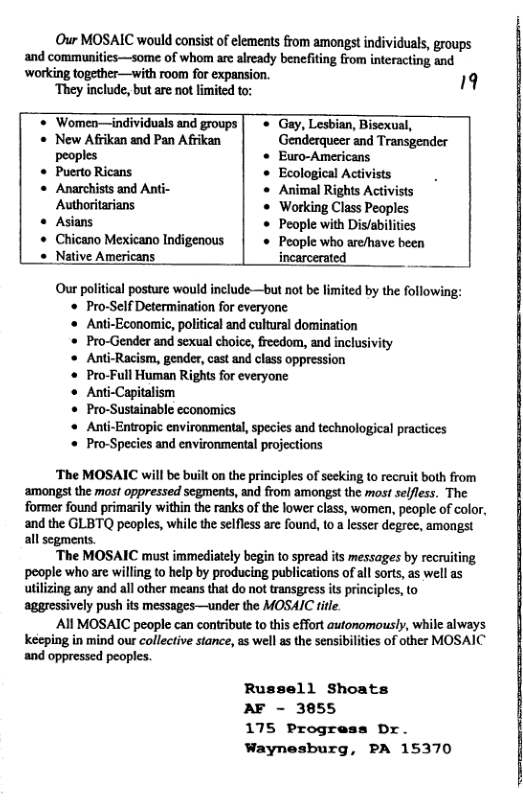
Our MOSAIC would consist of elemeats from amongst individuals, groups
and communitics—some of whom are already benefiting from interacting and
‘working together—with room for expansion. 19
‘They include, but are not imited to:
* Women—individuals and groups * Gay, Lesbian, Bisexual,
« New Afrikan and Pan Afrikan Genderqueer and Transgender
peoples Euro-Americans
* Puerto Ricans. * Ecological Activists
« Anarchists and Anti- « Animal Rights Activists
Authoritarians « Working Class Peoples
o Asians « People with Dis/abilities
« Chicano Mexicano Indigenous |« People who are/have been
« Native Americans incarcerated _
Our political posture would include—but not be limited by the following:
Pro-Self Determination for everyone
Anti-Economic, political and cultural domination
Pro-Gender and sexual choice, reedom, and inclusivity
Anti-Racism, gender, cast and class oppression
Pro-Full Human Rights for everyone
Anti-Capitalism
Pro-Sustainable economics
Anti-Entropic environmental, species and technological practices
Pro-Species and environmental projections
‘The MOSAIC will be built on the principles of secking to recruit both from
amongst the most oppressed segmens, and from amongst the most selfless. The
former found primarily within the ranks of the lower class, women, people of color,
and the GLBTQ peoples, while the selfess are found, 10 a lesser degrec, amongst
all segments.
‘The MOSAIC must immediately begin to spread its messages by recruiting
poople who are willing to help by producing publications of all sorts, as well as
utilizing any and allother means that do not transgress is principles, o
aggressively push its messages—under the MOSAIC fite.
All MOSAIC people can contribute to this effort autonomously, while always
keeping in mind our collective stance, as well as the sensibilites of other MOSAIC
and oppressed peoples.
Russell Shoats
AF - 3855
175 Progress Dr.
Waynesburg, PA 15370
Finally, the MOSAIC must immediately begin a dialogue dircated toward
building 3 consensus—as near as possible—about how o best further coordinate
our collective efforts. Submit proposals for revisions of this drafi, questions,
comments, artwork, poetry, essays and other materials suitable for publication
under the MOSAIC name to Clarissa at
Clarissa Rogers
MOSAIC ¢/o The A-Space
4722 Baltimore Ave
Philadelphia, PA 19143
Or via email at: The_Mosaic@verizon net
Recommended Books (o Read
The Boni Maroon Wars in Suriname, Wim S.M. Hoogbergen (Academic
Publishers, 1997)
Voodoo in Haiti, Alfred Metraux (Schocken Books, 1972)
The Serpent and the Rainbow, Wade Davis (Simon and Schuster, 1985)
Hidden American: Maroons of Virginia and the Carolinas, Hugo Prosper Leaming
(Garland Publishing, 1995)
The Black Jacobuns. € 1R James (Random House, 1963)
Full Spectrum Disorder: The Military in the New American Century, Stan Goff
(Soft Skull Press, 2004)
Sex and War, Stan GofT (Lulu, 2006)
Marxism for Our Times: C.L.R. James on Revolutionary Organization, C.L.R.
James, edited by Martin Glaberman (University of Mississippi Press, 1999)
South Chicago ABC
ZIne Distro
Box 721/Homewood IL 60430